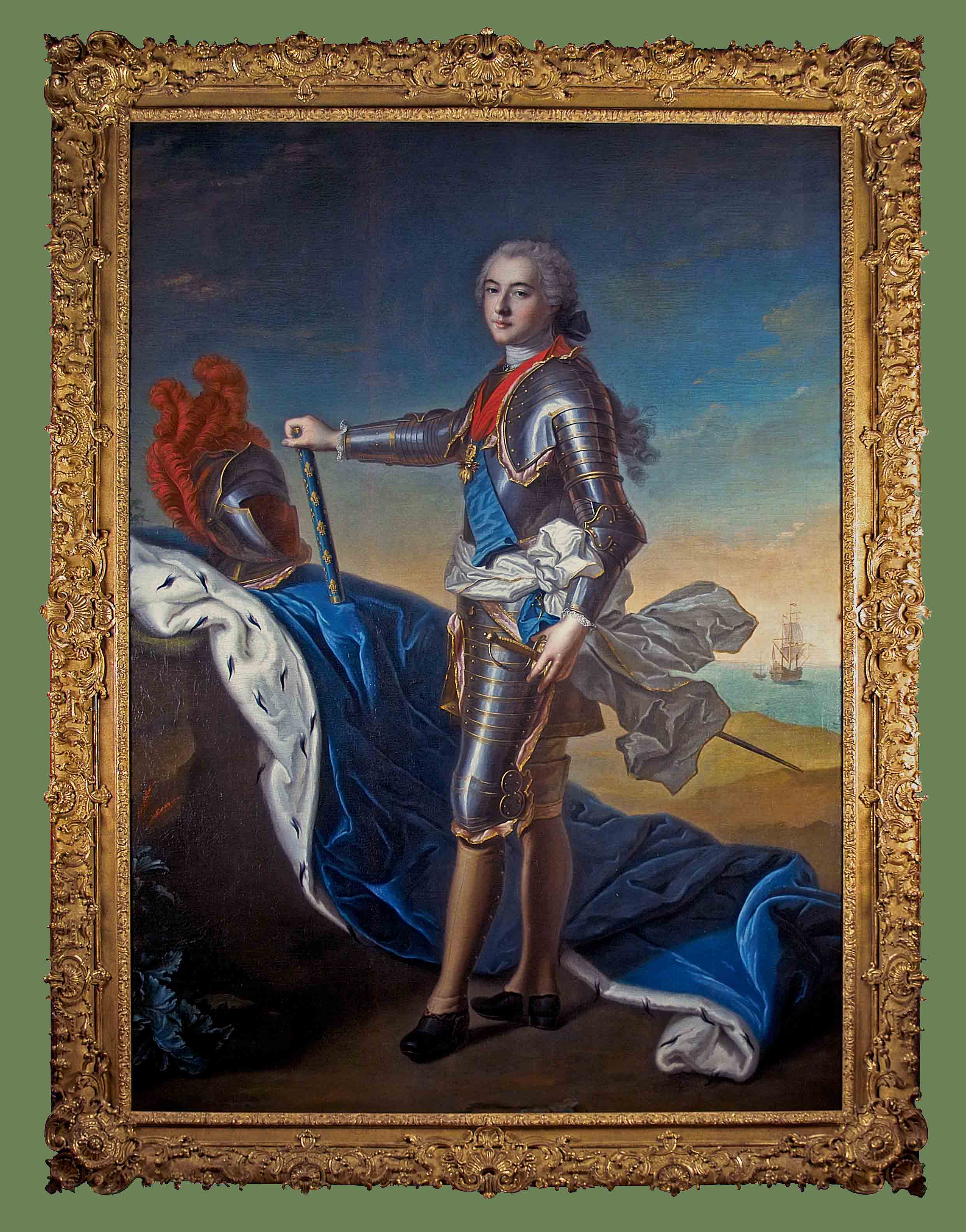
PORTRAIT OF LOUIS JEAN-MARIE DE BOURBON, French school, workshop of Jean-Marc NATTIER PERIOD: middle of the XVIIIth century, circa 1745 TECHNIQUE:Oil on canvas DIMENSIONS: height 80; in width 57 in In addition to our painting, two are today recorded: A full length portrait of Louis-Jean-Marie de Bourbon, duke of Penthièvre, as Admiral of France, in front of a seascape, standing three-quater turned to the left, dressed in armour, the waist girt with the command official sash, the Order of the Golden Fleece hanging on a red ribbon around his neck, and the Order of the Holy-Spirit on a blue watered silk ribbon hanging across the shoulder. His left hand is holding his sword, with his right hand resting on his lilied command baton, with his ermine fur lined blue coat laying on a rock with his helmet. The duke of Penthièvre is represented as a military hero according to the shema popularized by Hyacinthe Rigaud through several portraits painted circa 1695-1700. LOUIS JEAN MARIE DE BOURBON (1725-1793): Only son of a Louis XIV and Madame de Montespans legitimated bastard, Louis Alexandre de Bourbon (1678-1737), Count of Toulouse, Duke of Penthièvre, and of Marie-Victoire de Noailles, he inherited at his fathers death in 1737 of his civil and military offices: Admiral of France, Governor of Brittany and Master of the Royal Hunt. In 1740 he was appointed chevalier of the Order of the Golden Fleece, then in 1742 chevalier of the Order of the Holy-Spirit. In 1744, he married Marie-Thérèse Filicit of Este-Modene who gave him seven children. His main hobby was his collection of watches, which he liked to regulate and repair himself. He was especially the owner of the castles of Sceaux, Anet, Aumale, Dreux and Gisors, Blois, Amboise and also of the Hôtel de Toulouse in Paris (today center of the Bank of France). His favourite residence was the château de Rambouillet, the gardens of which he embellished and which he had to give up to King Louis XVI in 1783. In return, he bought to the Duchess of Choiseul the beautiful castle of Chanteloup. JEAN-MARC NATTIER (1685-1766): Son of the portraitist Marc Nattier and of the miniaturist Marie Courtois, he showed very soon a gift for drawing thanks to which he was admitted to follow the lessons of the Académie Royale de peinture, with his elder brother Jean-Baptiste. He was received member of the Academy in 1718 with the presentation of his reception work Perseacute;e changeant Phineacute; en pierre (Musèe des Beaux-Arts, Tours). Circa 1735, Nattier perfected the formula which made him so successful as portraitist: a range of colours associating blue, pearl grey, green and rose, a matter set in light and downy touches which give a lightly blurred aspect to the flesh and which emphasize the volume, the embellishment of the models while keeping the resemblance. BIBLIOGRAPHY: E. Benezit, Dictionnaire des Peintres Sculpteurs, Dessinateurs et Graveurs, vol. 6, Librairie Grand, 1966 |